

California’s 2026 governor’s race may produce a paradox: in a state where Democrats dominate statewide elections, the final ballot could feature only Republicans.
The reason isn’t ideology. It’s structure.
Under California’s “top two” system, all candidates from all parties compete in the first round and only the two highest vote-getters advance. When one side fragments and the other consolidates, the system can exclude an entire coalition—even if that coalition represents a majority of voters.
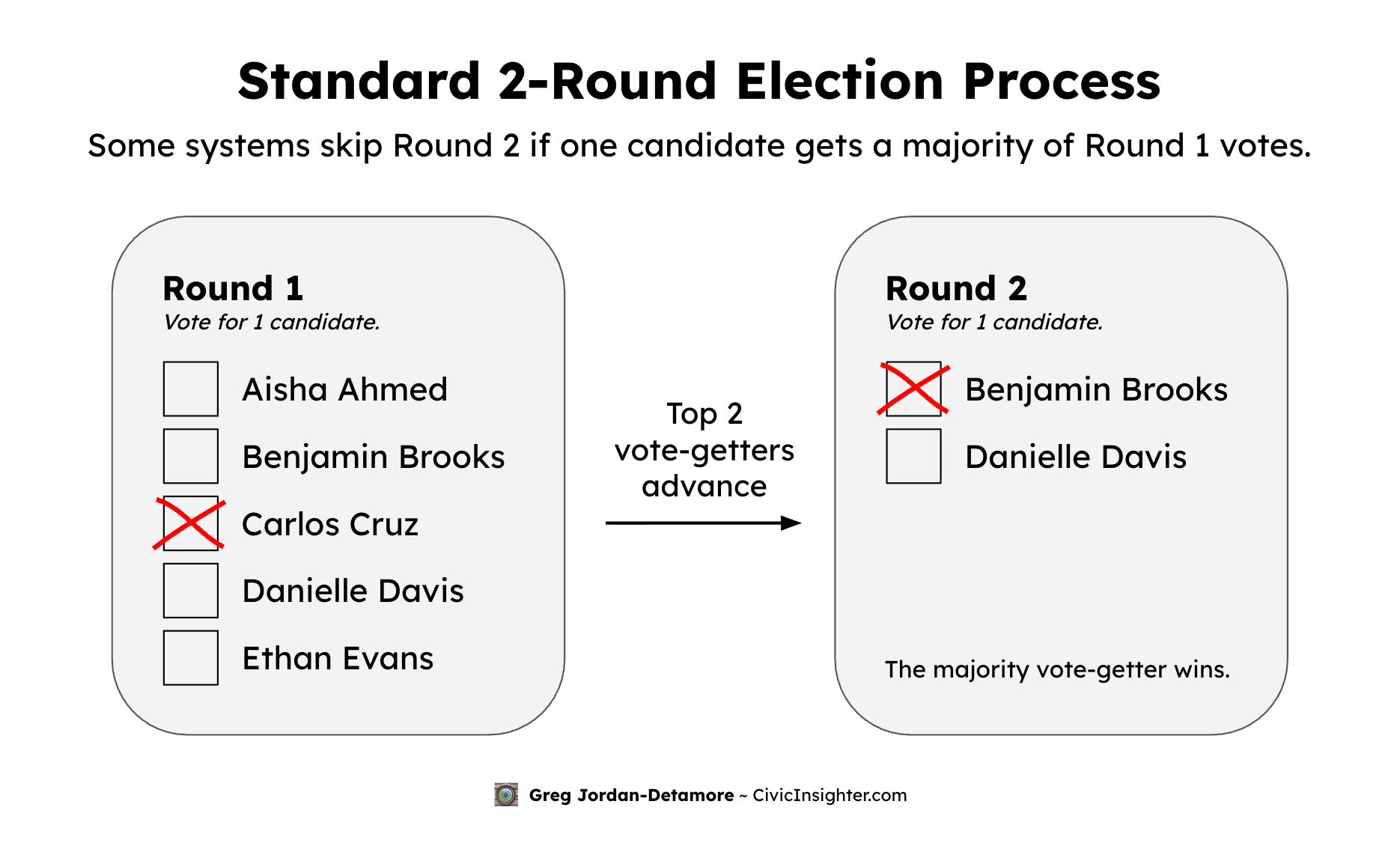
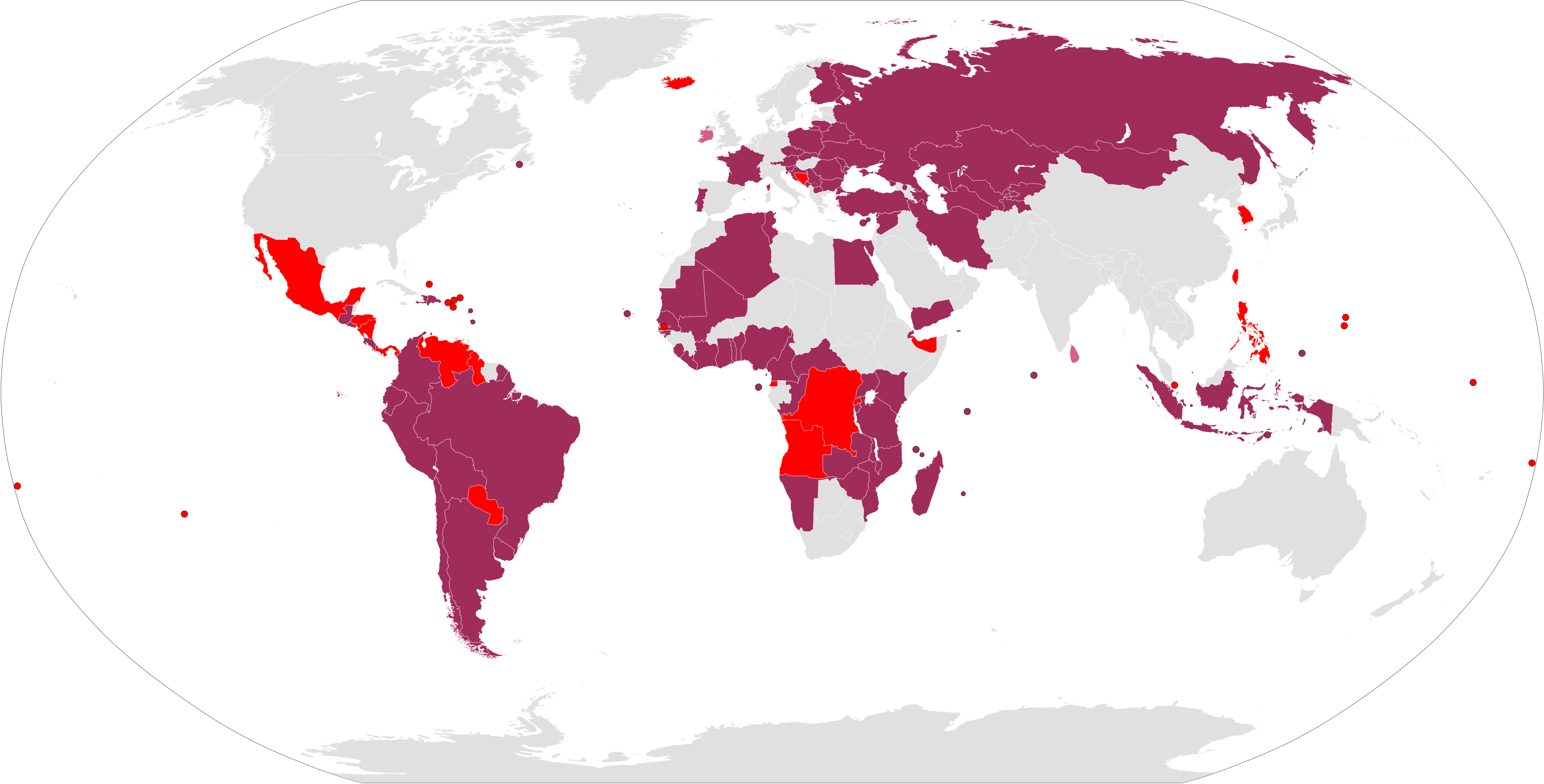
This coordination trap isn’t unique to California. Runoff elections across the globe repeatedly produce the same pattern: voters must guess which candidates have a “viable” shot and pool support behind them, or else risk unexpected consequences.
France learned this in 2002. Peru saw it in 2021.

The good news: one small change, currently used in the city of St Louis, could substantially reduce this risk—without overhauling the elections process or ballot design.
Chaos in California
California’s current race for governor illustrates this problem.
The top two candidates in this year’s first-round election will face off in the second round in November. In a state that’s dominated by Democrats, numerous recent polls show the top two candidates may be Republicans:
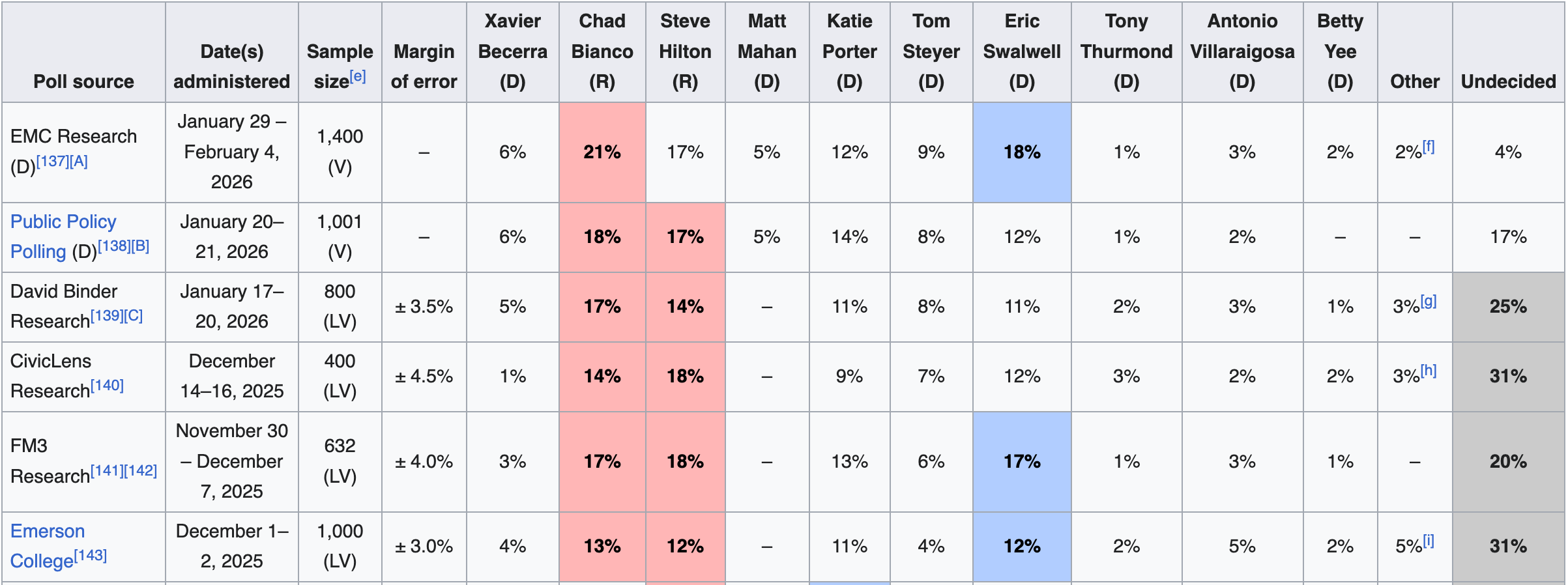
If the first round were held today, it could result in Democrats being “locked out” of the final election.
As John Mulholland writes in State Affairs:
While Republicans are largely consolidated behind two candidates, Democrats are spread across a sprawling field. The Republicans can carve up 40% of the vote between them, while a much larger number of Democrats scrap over the remaining 60%.
The specter of a Republican-only runoff is drawing anxiety among Democrats since the electoral consequences would be severe.
I suspect many Democrats will try to coalesce around one candidate. But which one? There are two (Eric Swalwell and Katie Porter) with similar levels of support.
This concern is not new. “Almost every year, the prospect of one party getting shut out from the November ballot, because an overabundance of candidates splits the primary vote, sends activists and political strategists into flights of panic,” writes Ben Christopher. (Versions of this system are also used in states like Washington and Louisiana.)
Some candidates try to work the system by spending money to boost a candidate from the other party, as a way of either helping themselves get on the second-round ballot or trying to keep a threatening competitor from their own party off the second-round ballot.
Frustration in France
France uses a runoff system to elect its president. For decades, the pattern was familiar: mainstream center-left and center-right candidates would be the top two in the first round, then face off in the second round.
In 2002, that pattern broke.
Far-right candidate Jean-Marie Le Pen had previously hovered around 15% in prior first-round presidential elections. In 2002, he got 16.9% of the first-round vote—roughly in line with expectations.
Center-right incumbent Jacques Chirac got 19.9%.
But the left-wing vote fractured across multiple candidates. Lionel Jospin, who was expected to qualify for the runoff, got just 16.2%—finishing slightly behind Le Pen and missing the second round by less than one percentage point.
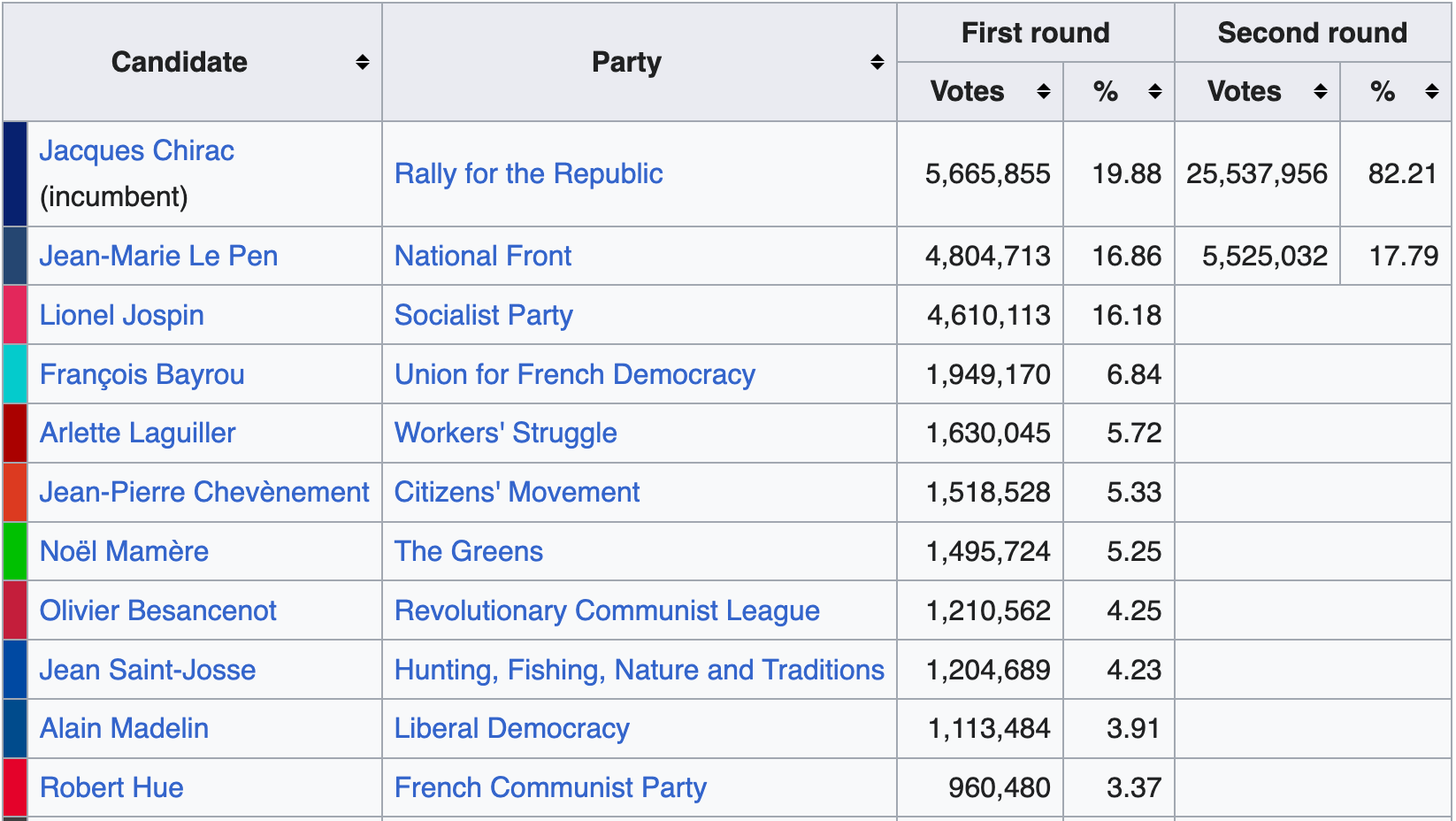
In the second round, people across the political spectrum rallied around Chirac, who earned 82% of the vote vs. Le Pen’s 18%. So voters did avert the election of a widely-disliked candidate.
But France was supposed to have a competitive election.
Opinion polls prior to the first-round election—which had assumed that Chirac and Jospin would advance to the second round—showed a close race, with each candidate earning at least 48% support:
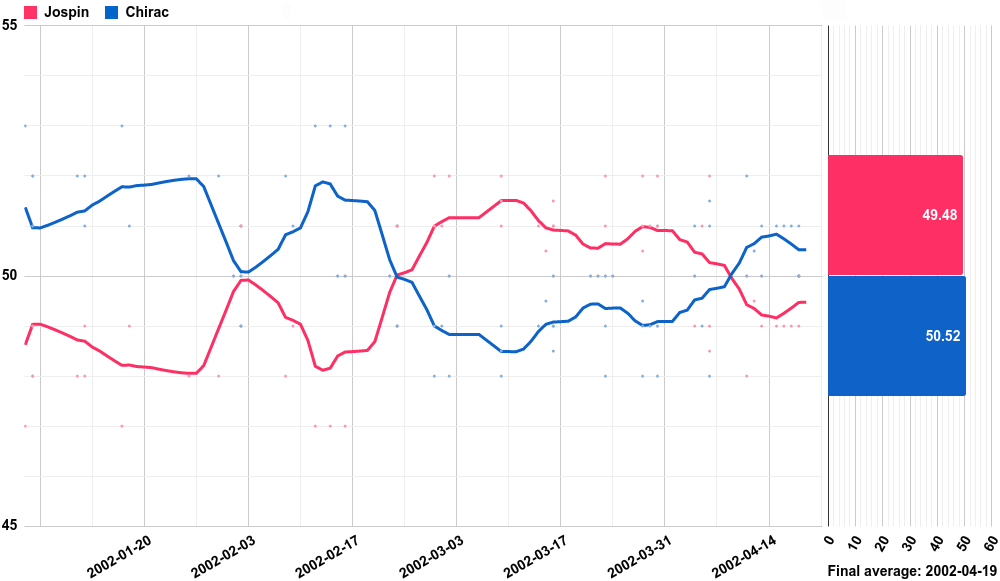

When multiple similar candidates split support in the first round, even small miscalculations can change who advances to the second round. Voter coordination is critical.
Problems in Peru
“Just do a better job at coordination” sounds like great advice—but what do you do when it’s not ever clear which candidates voters should coalesce around?
Peru’s 2021 presidential election had 18 candidates. Of them, 9 got at least 5% of the first-round vote, and 4 got at least 11%. The top vote-getter only got 19%.
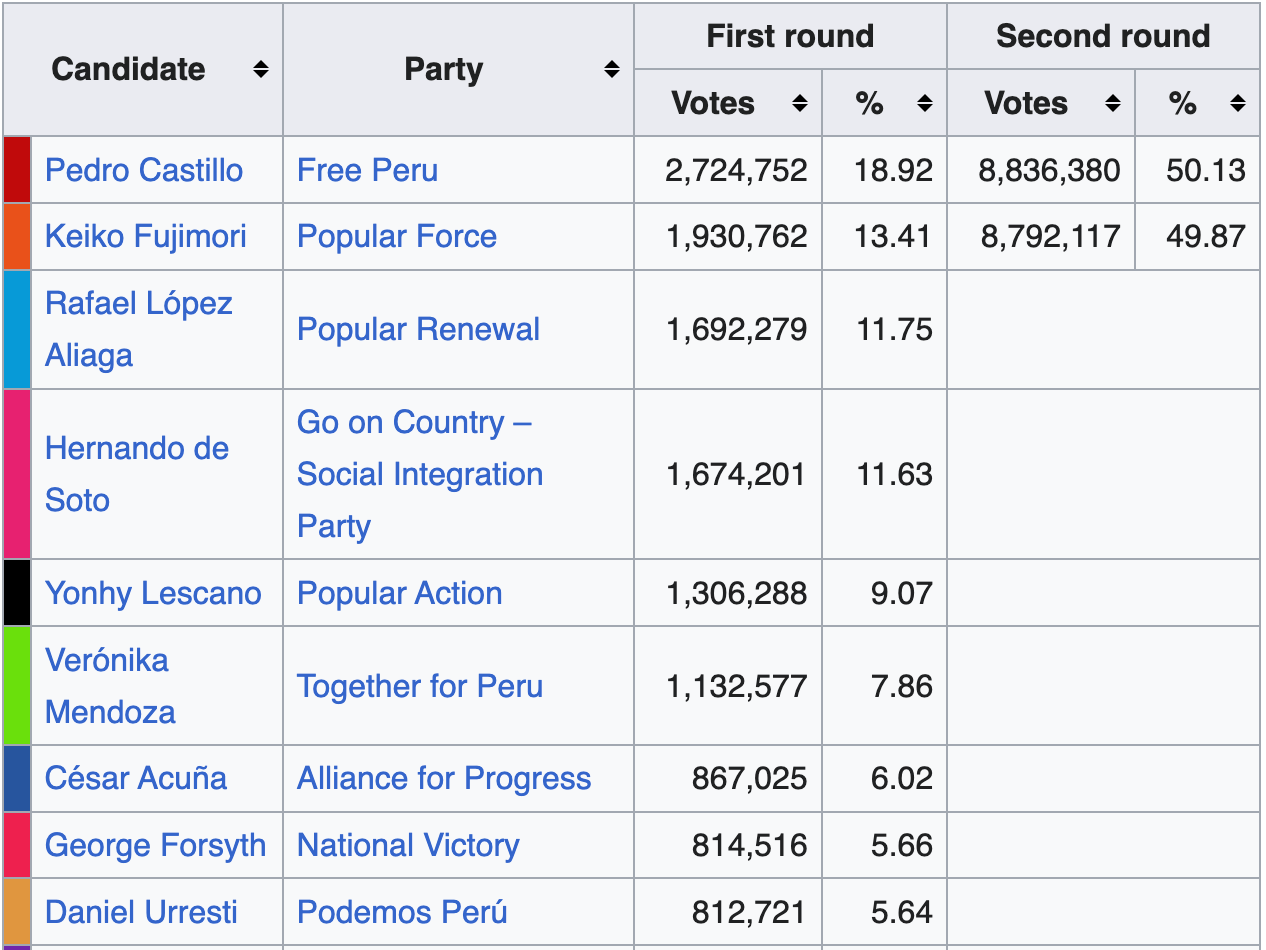
Small shifts—just one or two percentage points—could have changed who advanced to the second round, and ultimately the outcome of the election.
And unlike France in 2002, there was no obvious focal point for coordination. With multiple viable candidates clustered closely together, it was unclear who voters should strategically consolidate behind.
Pre-election polls were all over the place:
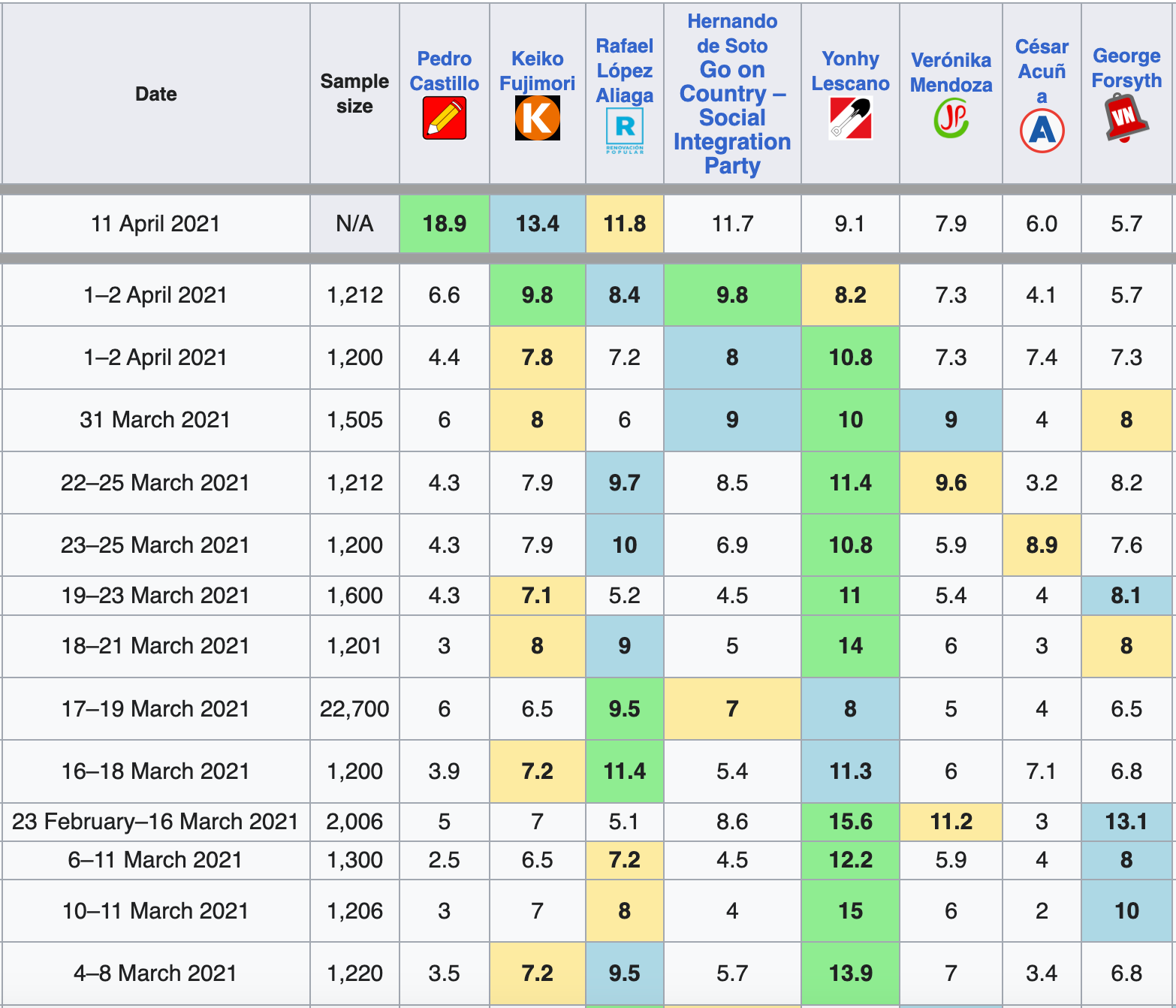
In a field that fragmented, even well-intentioned voters had little reliable guidance.
The runoff ultimately featured Castillo and Fujimori—a highly polarizing matchup with both candidates widely disliked. But the first-round vote totals suggest that different pairings were possible under slightly different strategic behavior.
Note that the 2nd-, 3rd-, and 4th-place finishers in the first round (Keiko Fujimori, Rafael López Aliaga, Hernando de Soto) were all right-wing candidates. From what I’ve read, Hernando de Soto was positioned as a more “moderate” candidate. If he had been the right-wing candidate to advance to the second round, it’s conceivable he could have won the election against left-wing Castillo. Of course, we can’t say for sure.
In a system that allows only one vote in the first round, voters must both express preference and solve a coordination puzzle at the same time. In highly fragmented races, that puzzle can be nearly impossible.
In Peru’s 2026 election, there are 34 candidates. Good luck trying to figure out what to do there!
One small change that can make a big difference
One simple change could meaningfully reduce risk: in the first round, let voters select as many candidates as they want rather than limiting them to one.
Everything else stays the same: the top 2 vote-getters advance to the second round, where you vote for 1 candidate and then the majority wins.
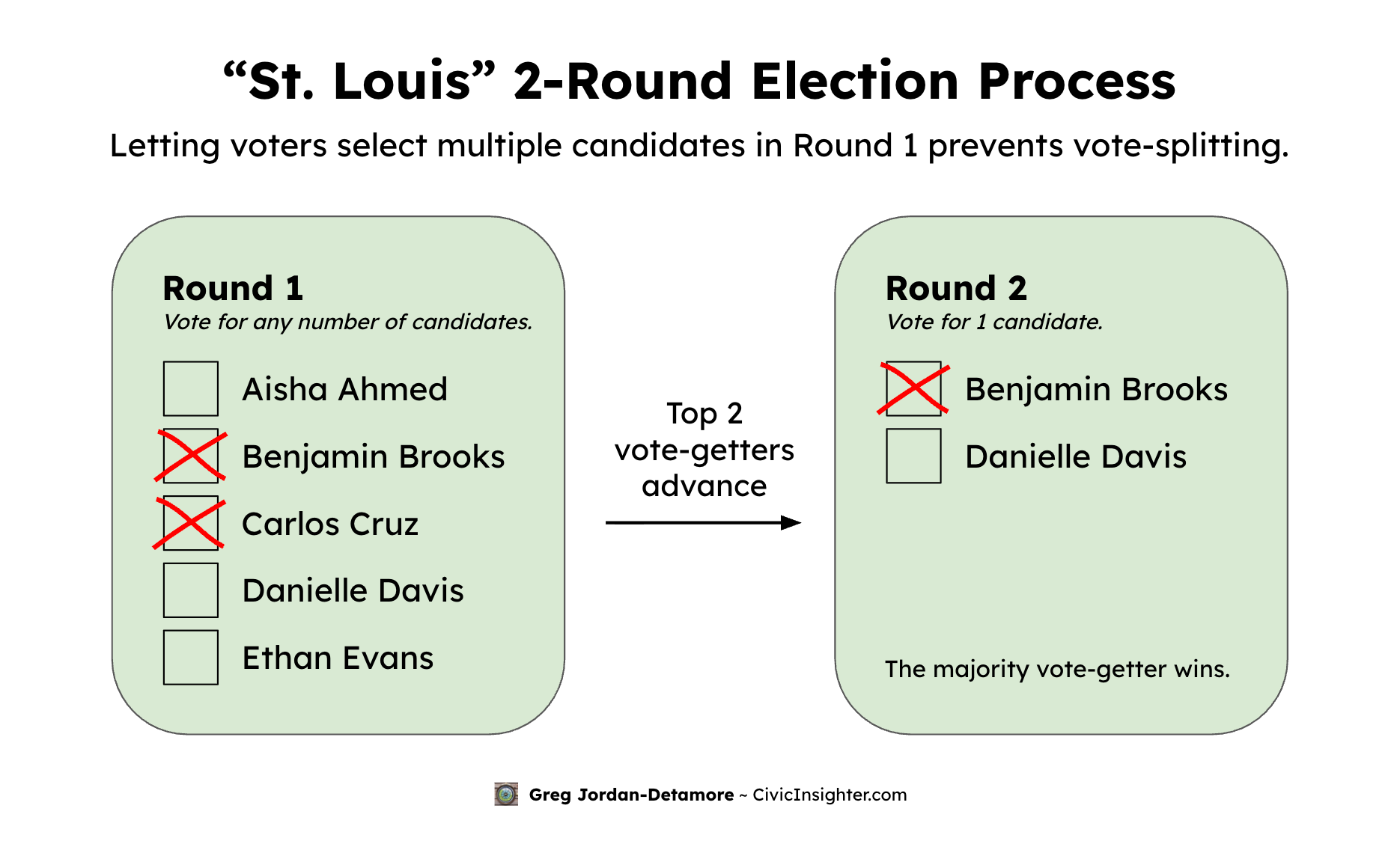
Now, instead of fracturing support across multiple similar candidates, voters can vote to advance any candidates who they want to have a shot at being on the final ballot. Candidates can cross-endorse each other, saying: “Vote for both of us, and hopefully one of us makes it to the second round!”
Then the 2 candidates with the broadest support across the electorate face off in the second round, where:
If one of your selected candidates made it to the second round, great—vote for that person!
If you got really lucky and two of your selected candidates ended up being the two finalists, you get the luxury of deciding between them in the second round!
If unfortunately none of your selected first-round candidates made it to the second round, you’ll still get the chance to choose between the top two choices of the rest of your fellow voters
If everyone just selected one candidate in the first round (“bullet voting”), then you’d basically have the same result as the current system. So we have to see what actually happens in the real world.
Putting principles in practice
This system has been used for municipal elections in St Louis, Missouri, since 2021.
In the 2021 mayoral primary, the average voter selected 1.6 candidates from the 4 options. In 2025, the average voter selected 1.4 out of 4. So while plenty of people did bullet vote, plenty did not. The portion of voters who selected multiple candidates is easily large enough to make a real difference in avoiding vote-splitting and “lock out” problems. Remember how close some of the first-round vote totals were in examples above like France or Peru; tiny shifts can change who advances.
There’s some evidence suggesting voters select more candidates when given a larger candidate field. For example, experiments in France showed that on average voters approved between 2 and 3 presidential candidates, out of 12 candidates in 2007 and 10 candidates in 2012. (These experiments were conducted at the same time as the real elections, but did not count toward the election results.)
Lament in Louisiana
Louisiana’s 1991 governor’s race was an example of where the usage of the St Louis system may have actually made a difference.
The election featured 4 major candidates:
Democrat Edwin Edwards, former governor
Republican (former Democrat) Buddy Roemer, incumbent governor
Republican Clyde Holloway, U.S. Congressman
Republican David Duke, former Ku Klux Klan leader and white supremacist
Here’s how the first round went:
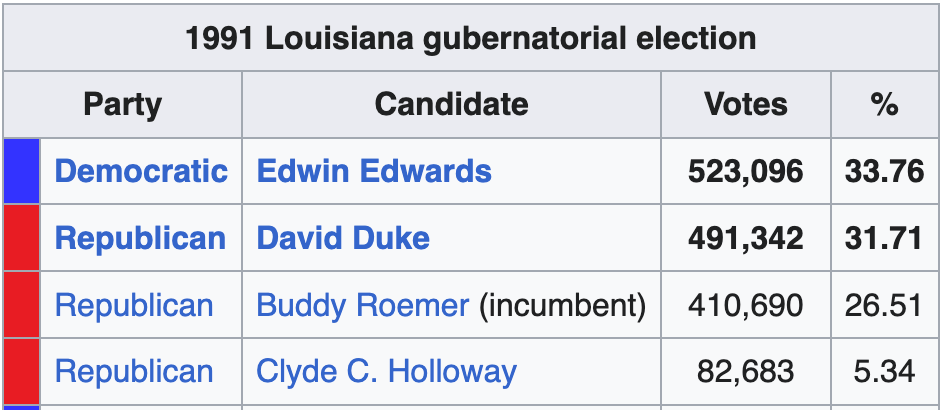
Democratic votes were consolidated behind Edwin Edwards, while Republican votes were split across several different candidates, with David Duke getting the highest number and advancing to the second round.
This set off a frantic anybody-but-Duke campaign in which lots of people who otherwise would not have voted for Edwin Edwards did so in order to avoid the election of David Duke. In the second round, a large majority of voters coalesced around Edwards and he won.
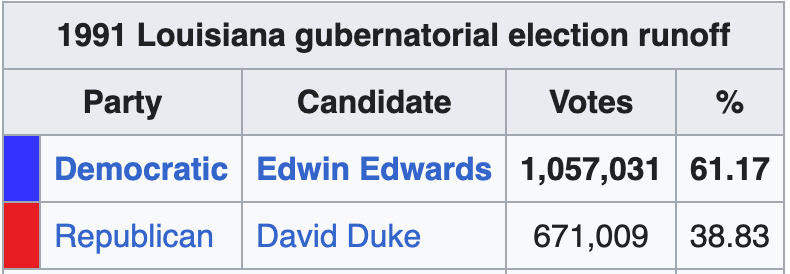
In the final round, 61% voted against David Duke, but in the first round 64% had voted for a Republican. Is it possible that incumbent Buddy Roemer would have been the candidate whose election would have left the largest number of people at least somewhat satisfied? Perhaps, though we’ll never know because the election system didn’t give us the chance to find out.
Under the St Louis system, voters could have selected multiple candidates to advance—for example, Buddy Roemer and Clyde Holloway, or Edwin Edwards and Buddy Roemer. I think there’s a decent chance that the final round would have been Edwards vs. Roemer—and in such an election, Roemer may have stood a good shot at winning. (Though note that this was not a simple “left vs. right” election.)
Not a magic wand
In many cases the St Louis system (or any alternate system) wouldn’t change the final result, as many elections have a clear front-runner who would likely win no matter what the rules are.
For example, Chile’s 2025 presidential election and Chicago’s 2023 mayoral election both featured messy fields of 5 major candidates with highly-fractured first-round vote totals. They seem like the kind of elections where the St Louis system would really help. But when you learn more about the specific candidates, including their coalitions and political views, I think it’s likely the outcomes of these elections would not have changed.
Changing campaign incentives
Even when it seems the outcomes won’t change, the St Louis system would at least likely make for a more cordial first round, as similar candidates can cross-endorse each other rather than fighting each other. In a vote-for-one system, attacking adjacent rivals is rational; in a vote-for-multiple system, coalition-building is rational.
And in polarized political environments, this system can provide a real incentive for candidates to bridge the divide between the two “sides” and try to appeal to a wider swath of the electorate—since voters can select multiple candidates across parties (or factions) on the same ballot. Maximizing broad appeal is how you maximize your chance of making it to the second round.
If the changed campaign incentives get more consensus-building candidates onto the second-round ballot, that could ultimately get more of them elected, making for a healthier politics.
Evolution, not revolution
Talking about “how might everything change if we had a different election system” is fun, but the hard reality is that it’s often difficult to get public support for big structural changes, especially ones that may require a constitutional amendment.
The change that I’ve outlined here explicitly uses three design constraints:
No ranking or scoring of candidates—as that typically requires significant voter reeducation as well as changes to voting machines and ballot designs
Maintaining a two-round election system—as it’s familiar to many voters, and in some jurisdictions a “majority winner” is constitutionally required (necessitating a two-candidate runoff election)
Maintaining single-winner elected offices as they are—so no switch to proportional representation or other multi-winner systems
In my next posts, I will dive deeper into two specific issues:
How I did a “U-turn” on ranked-choice voting—switching from being a lifelong supporter to being a strong skeptic
What a better electoral system for single-winner offices would look like (besides the St Louis system)
Make sure to subscribe to get those posts straight to your inbox:
The St Louis system is not perfect, but it’s a dramatic improvement over the status-quo system in numerous countries and states—and a reform that may actually be within reach.
Are there also primaries? Or does the two round replace the primary?